
President Boakai Breaks Ground for US$363.9 Million Western Corridor Highway, Pledges World-Class Standards and Regional Transformation
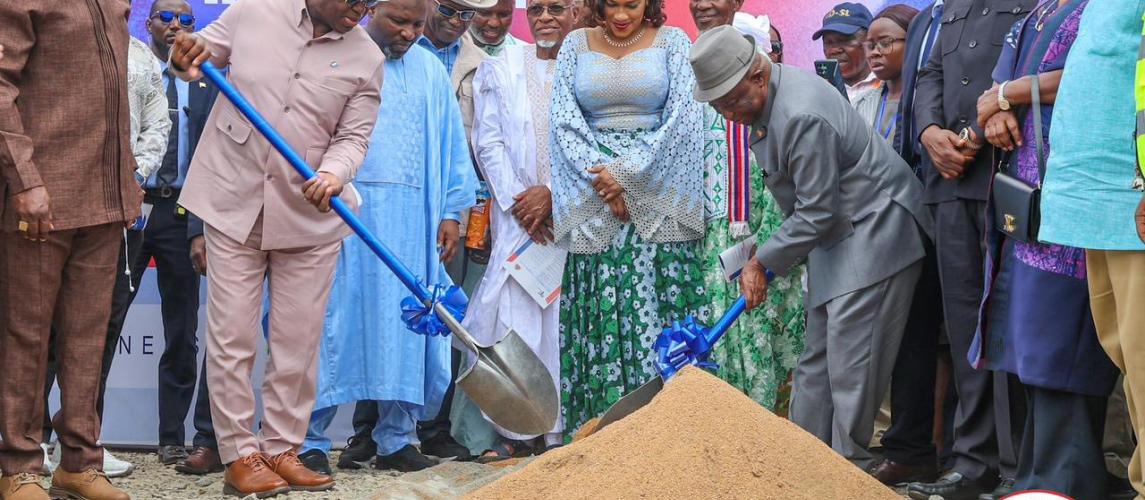
President Joseph Nyuma Boakai Sr. (right) and Julius Maada Bio (left) jointly break ground with ceremonial shovels at the 255-km Western Corridor road project in Liberia. Photo: Executive Mansion
Bo Waterside, Grand Cape Mount County – President Joseph Nyuma Boakai, Sr. has officially broken ground for the construction of a 255-kilometer Western Corridor road network, a landmark infrastructure project valued at US$363.9 million, aimed at transforming connectivity and economic activity across western Liberia.
The expansive initiative spans five major road corridors across four counties—Montserrado, Bomi, Grand Cape Mount, and Lofa. The project is expected to be completed within five years, following which it will transition into a long-term tolling, operations, and maintenance phase under a Public Private Partnership (PPP) Hybrid Annuity Model, blending EPC and BOT financing structures.
Speaking at the groundbreaking ceremony today, President Boakai described the Project as a defining step toward modernizing Liberia’s road infrastructure and unlocking economic opportunities across key development corridors.
,

President Joseph Nyuma Boakai Sr. (right) shares a laugh with Julius Maada Bio (left) at the groundbreaking of the 255-km Western Corridor road project in Liberia. Photo: Executive Mansion
,
“This Project will be built to international standards, with climate resilience, enhanced engineering, and a sustainable maintenance framework to serve both present and future generations,” the President assured.
The Western Corridor initiative forms part of a broader national infrastructure strategy designed to improve mobility, strengthen regional trade, and accelerate inclusive growth. Key components include the upgrading of the St. Paul Bridge to Klay road (38km dual carriageway), Klay to Bo Waterside (79km single carriageway), Klay to Tubmanburg (22km), Madina to Robertsport (30km), and Voinjama to Kolahun to Mendikorma (86km), totaling 255 kilometers.
President Boakai projected that, alongside the planned Mano River and Kongo corridors, the project will significantly boost cross-border trade and position Liberia as a critical gateway to the West African region.
“This is about dignity and opportunity for our people,” he stated, pointing out that, “It opens vital access routes, reduces travel time, lowers transportation costs, and connects communities that have long been isolated.”
,
Photo: Executive Mansion
,
,
The Liberian leader noted that the financing arrangement reflects a strategic collaboration between government and private sector partners, enabling the mobilization of nearly US$364 million to deliver durable and high-quality road infrastructure.
He further highlighted the social impact of the initiative, particularly for rural communities historically constrained by limited road access. “This is a transformational step in opening up the country and bringing tangible relief to our people,” he declared, adding that the Government remains focused on expanding development across all regions.
Also addressing the ceremony, the President of the Republic of Sierra Leone, His Excellency Julius Maada Bio, described the corridor as a symbol of progress and regional integration.
“The 255-kilometer corridor represents the future of West Africa,” President Bio said, adding, “It will connect nations, facilitate trade, and bring us closer as a region. What we witness today is not just infrastructure development—it is the dividend of peace, stability, and cooperation.”
The Western Corridor road Project is expected to serve as a major economic artery, linking Liberia’s western region to neighboring countries and enhancing trade flows, investment opportunities, and regional mobility.
