
Agriculture Ministry, KOICA Sign US$1 Million Grant to Empower Rural Youth in Rice and Cassava Value Chains
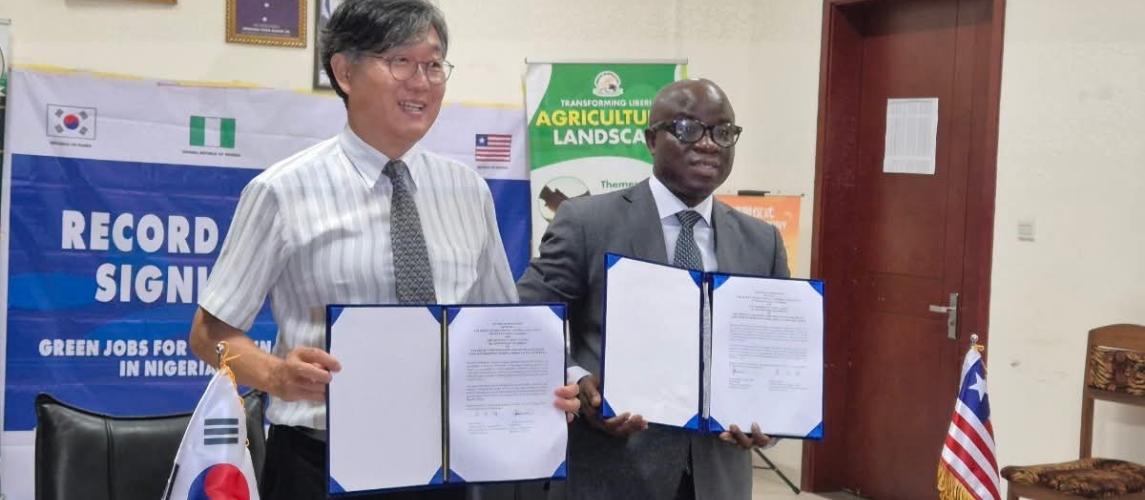

MONROVIA, LIBERIA – August 11, 2026: The Ministry of Agriculture (MOA) and the Korea International Cooperation Agency (KOICA) have signed a US$1 million grant agreement to equip rural youth with skills and opportunities to participate in Liberia’s rice and cassava value chains.
The initiative, titled “Green Jobs for Youth in Resilient Agrifood Systems,” will run through 2030, beginning with a pilot phase in Bong County. In Liberia, the project will be jointly implemented by the Ministry of Agriculture and the Food and Agriculture Organization of the United Nations (FAO), with support from KOICA.
Speaking at the ceremony today, Agriculture Minister Dr. J. Alexander Nuetah said the agreement demonstrates the Government’s commitment to increasing agricultural productivity while creating meaningful opportunities for young Liberians.
He said the initiative will encourage more young people to engage in the rice and cassava value chains, which are critical to Liberia’s food security and agricultural transformation.
“Currently, the Government is determined to increase rice production, and with this program, we will attract more young people to get involved in cassava and rice production,” Dr. Nuetah stated.
The Minister thanked KOICA for its support and assured the agency of the Government’s commitment to achieving the initiative's desired results.
KOICA Country Director for Liberia Kim Eunsub said the project is starting on a relatively small scale but could be expanded nationwide based on its success.
Mr. Eunsub also disclosed plans to explore scholarship and agricultural training opportunities in Korea for Liberians as part of KOICA’s broader capacity-building support.
For his part, FAO Officer-in-Charge Godwin Cudjoe welcomed the initiative, describing it as timely given Liberia’s youthful population. He stressed the importance of creating opportunities for young people beyond primary production, including in processing, marketing, transportation, machinery operations, and agribusiness.
“Agriculture and agrifood systems offer one of the most important avenues for doing so—provided that we move beyond seeing agriculture simply as farming and instead position young people across the entire value chain,” Mr. Cudjoe said.
Mr. Cudjoe emphasized that Liberia needs to make the rice and cassava value chains commercially attractive, technologically enabled and capable of generating decent employment.
The FAO Officer In Charge reiterated that the agreement is an investment in Liberia's young people and in the transformation of Liberia's agrifood system, pledging FAO's commitment to working with the Government, development partners, the private sector and young Liberians to strengthen skills, give them access to finance, technology, markets and entrepreneurship opportunities.
The Green Jobs for Youth in Resilient Agrifood Systems project is also being implemented in Nigeria and Sierra Leone. In Liberia, it is expected to contribute to efforts to increase domestic food production, strengthen rice and cassava value chains, create jobs, and expand economic opportunities for young people.
Representatives from the Ministry of Youth and Sports, the Ministry of Finance and Development Planning, the National Cassava Steering Committee, the National Rice Federation of Liberia, and other agriculture and youth-sector stakeholders attended the signing ceremony.
