
AGRICULTURE MINISTER NUETAH RALLIES DIASPORA INVESTMENT TO BOOST LIBERIA’S FOOD PRODUCTION
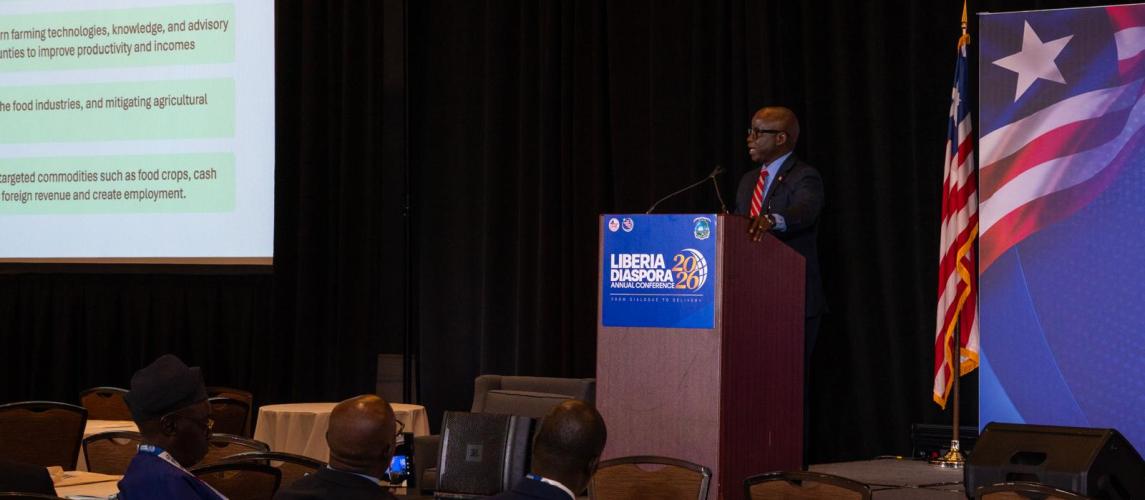
ALEXANDRIA, VIRGINIA, USA — September 26, 2026: Agriculture Minister Dr. J. Alexander Nuetah has urged Liberians in the diaspora to take a more active role in Liberia’s agricultural transformation by investing in food production, processing and agribusiness, as the Government expands critical infrastructure and support to unlock the sector’s potential.
Addressing the Liberia Diaspora Annual Conference 2026, Minister Nuetah outlined major interventions underway across the agriculture sector, including lowland development, mechanization, irrigation, feeder roads, extension services, and investments in rice, cassava, maize, cocoa, coffee, chilli pepper, and other value chains.
While highlighting these investments, the Minister stressed that the Government’s role is to create the enabling conditions for agriculture to grow. Still, the real impact will depend on farmers, agribusinesses and private investors putting those opportunities to productive use.
“The government can facilitate. We can build the infrastructure. But if the beneficiaries do not utilize it, we will not achieve anything,” Dr. Nuetah told the gathering.
He said this partnership between public investment and private production is particularly critical to reducing Liberia’s dependence on imported food, especially rice.
“We are importing over 60 percent of the rice we eat,” he said. “If you come to Liberia and grow more rice, we will have the market for it. We’ll buy it from you.”
To lower one of the biggest barriers to rice production, Dr. Nuetah said the Government has already developed about 16,000 hectares of lowland, providing farmers with production-ready land as Liberia works toward its 50,000-hectare lowland development target.
The government is also accelerating agricultural mechanization by establishing 13 Agricultural Mechanization Service Centers across six counties, designed to give farmers access to machinery needed to move from subsistence to more commercial production.
Dr. Nuetah said the Government of China is providing 304 pieces of agricultural machinery and equipment to Liberia as a gift, and that the equipment will strengthen farmers’ access to mechanized services.
The Minister also pointed to investments in agricultural infrastructure, including more than 200 kilometers of feeder roads, irrigation facilities and rural markets intended to improve production and connect farmers to markets.
On extension services, he said the Government has recruited 138 agricultural technicians to strengthen support to farmers. At the same time, a digital farmer-registration system is being introduced to identify farmers, understand where they are located, and better target agricultural assistance.
But Minister Nuetah stressed that increasing production alone will not transform the sector. Liberia, he said, needs greater private investment in processing, aggregation, storage, value addition and marketing to create reliable markets for farmers.
He identified rice, cassava, cocoa, coffee, maize, soybeans, rubber, chilli/cayenne pepper, cashew, and aquaculture as key areas offering investment opportunities.
For rice, Dr. Nuetah said investors can establish commercial farms or work with smallholder farmers as aggregators and processors, helping to address one of the major challenges facing producers—the lack of reliable off-takers.
He also highlighted growing opportunities in cassava, including processing and animal feed, and in maize, which is critical to strengthening Liberia’s poultry and livestock industries.
Minister Nuetah urged diaspora Liberians to leverage their capital, expertise, business networks and international connections to invest directly and attract credible partners into Liberia’s agriculture sector.
“We call upon you as Liberians in the diaspora to find opportunities there for investment in your country,” he said.
The Minister emphasized that Liberia has vast agricultural land, favorable climatic conditions, and significant domestic demand, providing a strong foundation for expanding commercial agriculture and reducing the country’s dependence on food imports.
The agriculture presentation formed part of the Liberia Diaspora Annual Conference 2026, bringing together Government officials, diaspora professionals, and other stakeholders to explore investment and collaboration opportunities for Liberia’s development.
—END—
